Showing posts with label pioneers. Show all posts

Monday, August 03, 2009

Women of the Apollo Program

Last month was the 40th anniversary of Apollo 11's historic moon landing. Watching the footage of of the landing makes it look like the Apollo program was men-only. But it was more complicated than that.

As Echidne points out:

But the absence of women astronauts in the program has a much more concrete reason: They were excluded from it. Books have been written about that: Margaret A. Weitekamp's Right Stuff, Wrong Sex and Stephanie Nolen's Promised The Moon.

And there were women involved with the project itself as described by Robyn C. Friend in The Women of Apollo. You can hear one of the original engineers, Ann Dixon[sic], speak about her experiences here:

Ann Dickson says she was "convinced that someday she was going to be an astronaut." Unfortunately that didn't happen, in part because she didn't have 600 hours of flying time.*

Ann Dixon wasn't alone in the Apollo program as this 1969 AP article explains:
Frances "Poppy" Northcutt, for example, is a 25-year-old Dayton, Tex., native who is a member of the flight dynamics support staff in mission control at the Manned Spacecraft Center. The tall, blonde mathematician is one of the first women to serve in an operational support role in mission control.
"There's less discrimination against women here than in any of the professional areas," she said.
The article goes on to mention Larue Burbank, designer of the visual displays used for real-time monitoring of spacecraft, and Dorothy Lee, an engineer who worked on the re-entry heat shields.

In a 1999 interview, Lee recalled being recruited by NASA (pdf):
... math was very easy for me just happened to be the easiest subject, and that's the reason I majored in math. Then when we were recruited - I say "we." There were several girls - I was from Randlph-Macon [Woman’s College, Lynchburg, Virginia]—who went to work for NACA at Langley [Research Center, Hampton, Virginia], and again I was put in the best division there. It was called PARD, Pilotless Aircraft Research Division. We had the exciting opportunities to launch vehicles, to test different configurations, and how those configurations would [ultimately design] spacecraft by virtue of the shape of the nose. We went from cones to blunt bodies. You see today your different vehicles are all blunt bodies. So I was right there and enjoyed it. It was fun.
[. . .]
Of course, today, NASA recruits all over the country, but back in 1948, which is when I graduated from college, and there were not many gals, we were hired as "computers." Computers didn't exist, you understand. We had calculators. They gave us civil service exams, and I was fortunate enough to pass the exam at a couple of grades higher than I was hired in, so I got raises.

But the thing that I would like to tell has something to do with Dr. [Maxime A.] Faget. Working as a computer, [later] we were classified as mathematicians. One day my project was to solve a triple integral for an engineer, so it didn't require using my calculator. I could just do it at my desk. Max's secretary was going to get married, and so I was asked to be his secretary for two weeks while she was on her honeymoon. [. . .] I would answer the phone, distribute the mail, and work my triple integral. I did this for two weeks. [. . .]
This Friday, the end of my two weeks, Max said, "Dottie, how would you like to work for me all the time?"
I thought he was being funny, because I don't type, and I knew that this was the last day and Shirley was returning Monday. I said, "Sure," in a very flip way. He gets up, goes downstairs to talk to the division chief, and he returns and he says, "Dottie, you start working for me Monday."
Well, I looked at him like, "All right," you know. So they found me a desk, and I was put with some engineers who were beautiful and taught me how to be an engineer. I learned on the job.
But not surprisingly, it was tall blonde Poppy Northcutt** who got attention in the press, particularly when she turned out to be the only woman working at Mission Control during the Apollo 13 emergency. And also, not too surprisingly, the article uses almost as many column inches asking her social life as it does talking about her work with the Apollo computer systems .

So yes, there were indeed a number of women mathematicians and engineers who played important roles in the Apollo program, even if they weren't astronauts.

That doesn't mean that they earned everyone's respect, of course. See, for example, this 1987 article in Popular Mechanics about the Space Shuttle program in the aftermath of the Challenger disaster in which retired Mercury and Apollo 7 astronaut Wally Schirra complains about women scientists and non-test pilots in the program (who he seems to equate with engineers):
To get ready for a serious relaunch, NASA will have to go back to using qualified test pilots only for the foreseeable future. It is ludicrous at this early stage of space exploration to allow a virtual passenger on the Shuttle to become known as an "astronaut." Such people have little to offer at an engineering skull session. I was appalled to see young women scientists in mission control acting as liaison with the Shuttle mission commander. This is not a job for a "show-and-tell" celebrity.
After that gratuitous swipe at women scientists (gratuitous because it's unlikely that the men scientists in mission control were pilots either), Shirra goes on to explain how Sally Ride is totally NOT an "engineering test pilot", so she should totally stop talking about "flying" the Space Shuttle.

But now, 40 years after Apollo 11, there are indeed women test pilot-astronauts, such as Eileen Collins, Pamela Melroy, and Susan Still Kilrain, along with many scientist and engineer-mission specialists like Heidemarie Stefanyshyn-Piper, Karen Nyberg, Megan McArthur, Julie Payette, Stephanie Wilson, Joan Higginbotham, Kalpana Chawla (killed on Columbia), Sandra Magus, and many many others.

Now if only we'd finally return to the Moon, or head out to Mars . . .

Further reading and watching :

* In looking for info about women in aviation I learned that in 1979 (10 years after Apollo 11) only 110 of 45,000 airline pilots were women. Even women who might otherwise be qualified for the astronaut program would likely have a hard time getting enough hours in the air to qualify.

** And cutely they named "Crater Poppy" on the moon after her. Later Northcutt entered politics, helping organize the 1977 National Women's Conference in Houston (watch the excellent Sisters of '77 documentary to get a sense of the historical importance of that event), and got her law degree.

Photo: "In 1959, Langley [Research Center] employed six women who were classified by NASA as "scientists." During the Apollo era, women made up 3 to 5 percent of the professional work force agency-wide. The percentage of African American professionals was significantly smaller, from 1.5 to 3 percent. These percentages rose slowly for both groups as the decade proceeded". Source: NASA

Tags: , ,

Tuesday, July 14, 2009

Ada Lovelace, Calculating and Fighting Crime

It's summer, so here's some light entertainment:

In honor of Ada Lovelace Day last March, Artist Sydney Padua created a comic featuring the mostly-true-except-for-the-inaccurate-bits story of Ada Lovelace's childhood, education, and her fateful meeting with Charles Babbage which ultimately lead to their crime-fighting partnership (I mentioned the inaccurate bits, right?). It's steampunk, it's geeky, and it's got copious explanatory notes - what more does a comic need?

Check out Ada Lovelace - The Origin. Then read the continuing adventures of Lovelace and Babbage:

The real Ada Lovelace began her life-long friendship Cambridge mathematics professor Charles Babbage when she was just 17 years old. The two corresponded on mathematics, logic and other topics, and, in the process of writing a description of Babbage's proposed "Analytical Engine" created the very first computer program. Ada married William King at the age of 19, had three children, and sadly died of cancer in 1852 at the age of 37. As far as we know, she and Babbage had no crime-fighting adventures , but it's fun to consider what could have been.

(via Making Light)
Tags: , ,

Thursday, July 09, 2009

Sylvia Earle: Marine Biologist and Aquanaut

A few days ago the KQED public television program QUEST profiled pioneering marine biologist and explorer Sylvia Earle, which has given me the kick in the rear I needed to finish this post that's been sitting as a draft for several months.

In 1970 Sylvia Earle lead an all-female team of "Aquanauts" that lived for two weeks in an underwater habitat - Tektite II - off the Virgin Islands. The project was partially funded by NASA, which was interested in how teams would work in an isolated closed environment. Others on her team were Renata True of Tulane (now at College of the Mainland in Texas), Scripps graduate students Ann Hartline and Alina Szmant (now at University of North Carolina, Wilmington), and engineer Margaret Ann Lucas.

Their mission wasn't just focused on learning to work together as a team and studying the local flora and fauna. They were also testing newly developed diving equipment. Astronaut Scott Carpenter noted that when he visited Tektite II and wrote about it for Popular Science:

Their professional skill impressed me, and so did their self-reliance. With no male help wanted, they toted their own tanks and other heavy gear. [...] On a swim the day before, I saw the team prepare equipment for another ecology study by Ann Hartline and Alina Szmant. Peggy Lucas, the team's engineer, went along on another occasion, when all five girls were in the water at once.

That was a rare and somewhat eerie sight. Five girls clad in bright-orange wetsuits, with stark white backpacks, working on their projects in brilliant blue-green water, [...] a splash of color I'll remember [...]. An unusual part of the spectacle was the absence of bubbles.

The team was building up experience with closed-circuit, mixed-scuba - an innovation that their Tektite II mission would be the first to put to use. Instead of exhausting a diver's exhaled breath to the sea, as an open-circuit scuba does, it absorbs carbon dioxide and recovers unused oxygen, to supplement the mixture entering the inhalation bag from the tanks.
If you can overlook the patronizing tone (I hate when adult women are called "girls"), it's an interesting look at the development of new technology.

When they emerged from their habitat they were instant celebrities, and were treated to a ticker-tape parade in Chicago and invited to lunch at the Whitehouse. Not surprisingly the press focused on the novelty of women scientists. For example this Associated Press article published in the Spokane Daily Chronicle gives us the important details about the Aquanauts' average height, weight and preferred hair styles (petite with pony tails, if you must know). However, it also included this great quote:
"Sometimes people find it hard to take us seriously," says Dr. Sylvia Early[sic] Mead, 34, of Los Angeles, the team leader. But she adds, "Most of the problems are in the minds of the men."
Since 1970 Earle has never let up on her exploration of the oceans - she set several diving records, walked on the ocean floor 1250 feet below the surface, and became the first female chief scientist at the National Oceanographic and Atmospheric Administration. She has also lead the Sustainable Sea Expeditions, a project to research and promote the US National Marine Sanctuaries, and her work as an advocate for oceans and its denizens Time magazine named her a "hero for the planet".

She acknowledges that her devotion to her work may have strained her first marriage. However, she was able to figure out how to combine career and family, despite her frequent field trips:
It is a problem trying to combine having family and being as enthusiastic about a specialty as I have always been. I have managed it in part through ingenious rearranging of a life, I suppose. Having a laboratory set up at home. I always had a microscope -- not a big, fancy, sophisticated microscope, but something that would make it possible for me to work at home. And I have a professional library that I have accumulated all my life. The big professional libraries do provide the necessary access to a world of information, but I have managed to gather a nucleus of books at home that are like an extension of my mind. My favorite wall paper is books. I can't possibly keep everything in my brain, but if I have access to it, and know where to get it off the shelf, that's like having an extension -- a bigger brain. That's certainly true with computers now.
Earle's husband and parents helped take care of the kids while she was traveling, and her they were also occasionally taken out of school to "dive with the whales in Hawaii" or travel "to the Bahamas and dive with a friendly dolphin" (how cool is that?). Earle's children learned to love the oceans too:
Ms. Earle said her son works for California Fish and Game, catching the “bad guys who take more abalone than they should.” Her older daughter, whom she described as hating math since the 6th grade because of a discouraging teacher, now runs the company Ms. Earle started, Deep Ocean Engineering. And her younger daughter now does deep sea diving in submarines.
Watch the QUEST segment on Sylvia Earle either below or at KQED.com.

QUEST on KQED Public Media.

More about Sylvia Earle:
Image: "During the National Geographic/Sea Stories filming, Dr. Earle explains to Emma, the uses and benefits of deploying the DeepWorkers in the Sanctuary system." (from sanctuaries.noaa.gov)
Tags: , ,

Sunday, May 10, 2009

Happy Mother's Day!

Happy Mother's Day to all you mother-scientists and mothers of scientists!

Here are some great mother-scientist-appreciation posts I've been meaning to blog:

And happy Mother's Day to you mom!

Tags: , ,

Tuesday, May 05, 2009

Rita Levi-Montalcini: Still busy after a century

Times Online has an interesting article about neuroscientist Rita Levi-Montalcini, who tuned 100 on April 22. She has lead - or I should say is leading - a fascinating life.

Levi-Montalcini enrolled in medical school at the University of Turin in 1930 over her father's objections.

The initial obstacle to entering university was not Fascism, but her father. In her autobiography she writes that she and her twin sister Paola (an artist who died in 2000 and whose artworks decorate her office walls) were born to Adamo Levi, “an electrical engineer and gifted mathematician”, and Adele Montalcini, “a talented painter and an exquisite human being”.
[...snip...]
“[My father] loved us dearly and had a great respect for women, but he believed that a professional career would interfere with the duties of a wife and mother. He decided that the three of us - Anna, Paola and I - would not engage in studies which open the way to a professional career, and that we would not enroll in the University.”

She enrolled anyway, earning her degree in medicine and surgery in 1936. She wasn't sure if she wanted to pursue neurology research or focus on medicine, so she chose to enroll in further coursework to specialize in neurology and psychiatry.

Her academic career was cut short, however, when Mussolini issued his Manifesto of Race which barred Jews like Levi-Montalcini from academic and professional careers. Rather than flee the country, she decided to stay in Italy and continue her work on her own:
The two alternatives left then to us were either to emigrate to the United States, or to pursue some activity that needed neither support nor connection with the outside Aryan world where we lived. My family chose this second alternative. I then decided to build a small research unit at home and installed it in my bedroom. My inspiration was a 1934 article by Viktor Hamburger reporting on the effects of limb extirpation in chick embryos. My project had barely started when [Italian histologist] Giuseppe Levi, who had escaped from Belgium invaded by Nazis, returned to Turin and joined me, thus becoming, to my great pride, my first and only assistant.

The heavy bombing of Turin by Anglo-American air forces in 1941 made it imperative to abandon Turin and move to a country cottage where I rebuilt my mini-laboratory and resumed my experiments. In the Fall of 1943, the invasion of Italy by the German army forced us to abandon our now dangerous refuge in Piemonte and flee to Florence, where we lived underground until the end of the war.
When the British and American armed forces forced the Germans out of Florence in 1944 she was hired as a physician to minister to a war refugee camp, which housed Italians who had fled the continued fighting in the North. When the war was over, she and her family returned to Turin where she resumed her academic position at the University.

But her life was to change once again. In 1947 developmental biologist Viktor Hamburger invited Levi-Montalcini to join him in his lab at Washington University in St. Louis. She had intended to stay there for 10 months, but actually ended up remaining there for 30 years. She was hired as an Assistant Professor in 1956, and promoted to Full Professor in 1958.

While she made her home in the US she didn't neglect her Italian roots: in 1962 she established a research unit in Rome, splitting her time between there and St. Louis. And in 1969 she became the Director of the Institute of Cell Biology of the Italian National Council of Research.

It was at Washington University that Levi-Montalcini and Stanley Cohen first isolated Nerve Growth Factor from tumor cells. They received the Nobel Prize in Physiology or Medicine for that work in 1986. As she told the Times:
Her discovery, she says, was the highlight of her long life. “I immediately understood the importance of this discovery, which is more important today than it was then and which went completely against the dogmas of the time. The recognition in Stockholm gave me great pleasure, but it does not compare with the moment of the discovery itself, when I realised I was opening up a whole new scenario.”
Although she officially retired in 1977, she never actually stopped working as a scientist. Five years ago she founded the European Brain Research Institute (EBRI) in Rome. That is, in fact, where she spent her 100th birthday, attending a conference on "The Brain in Health and Disease" held in her honor.

She also has been working for social change. She (with her sister Paola) also founded the Rita Levi-Montalcini Foundation, which focuses on the education of girls and young women in Africa. In 2001 she was appointed an Italian Senator-for-life, a role she actively serves which she actively serves "unless busy in academic activities around the world"

And what is her secret to such a long and active life? She gets up early in the morning, eats very little, and keeps her brain active. She also supposedly doses herself every day with nerve growth factor eye drops, which may or may not have had a positive effect. She has also seems to have been blessed with general good health.

She has lived an amazing life, and shows little sign of slowing down. We should all be so active when we hit the century mark.

More information:
Publications:
(via Mind Hacks)

Photo (top): Rita Levi-Montalcini by Jollyroger on Wikipedia (2007)
Photo (bottom): Rita Levi- Montalcini viewing slides by Herb Weitman (1964)
Tags: ,

Saturday, March 21, 2009

Depictions of 20th Century Women in Science: The Smithsonian Collection

There's an interesting post on the National Museum of American History's blog by Arthur Molella about the way women are portrayed interacting with technology and science in 20th century photographs. Molella has focused on the images in the Smithsonian's Science Service Historical Image Collection, which distributed photographs to mainstream media outlets such as newspapers and magazines. One thing he noticed was that the women rarely appeared to be actively involved in scientific pursuits:

While there are literally hundreds of photographs of white-coated male researchers making or using scientific instruments, there are almost none of women doing comparable things. Rather, women are invariably passive or admiring observers. In other words, females are shown dominated by rather than in charge of technology.

Science Service images were typical of those presented by other contemporary media, save for the occasional movie about Madame Curie. None of this means, of course, that women did not play active roles in science and technology over the last two centuries. On the contrary, at the Lemelson Center we have uncovered ample evidence of significant female contributions. But, given the skewed nature of the visual record, we have had to work very hard to find this evidence. While image isn’t everything, it counts for a lot in today’s visual culture.

But that's not the end of the story. At The Bigger Picture, the Smithsonian's photography blog, Effie Kapsalis of the Smithsonian Photography Initiative was a bit surprised by Molella's observations, so did a little digging and discovered that the :
After giving a call over to [Smithsonian Institution Archives], I found out that when the Science Service records were transferred to the Smithsonian during the 1970s (over 500 boxes!), records were distributed throughout SI depending on their relevancy to a museum’s expertise and mission. So, for example, any material dealing with the history electrical innovation and invention went to the Division of Electricity and Modern Physics at what was then named the National Museum of History and Technology (now NMAH). Other parts of the Science Service records followed, going to other NMAH curatorial divisions, the Smithsonian’s National Air and Space Museum, National Museum of Natural History, National Portrait Gallery, and the Smithsonian Institution Archives. The women in the photos at the Lemelson Center indeed look more like early 20th century Vanna White’s then the women in the SIA records.
So the photos of actual women scientists were there in the initial collection. It does make me curious as to which images media outlets chose to run, but at least they had the option of choosing photos of women who weren't just admiring their reflections in the shiny equipment. (And as a side note, I think this exchange really exemplifies one of the advantages that news on the web has over news in the print media. If Molella's post had been a sidebar in a magazine, I likely wouldn't have seen the rest of the story.)

Kapsalis was familiar with the full extent of the Smithsonian's photo collection because they've been posting some amazing images of women in science on Flickr in honor of Women's History Month. Here's the collection's description:
Throughout March 2009, SIA will post groups of photographs showing women scientists and engineers at work; women trained in science and engineering who worked outside the laboratory as librarians, writers, political activists, or in other areas where their work informed or was informed by science; family research collaborators who assisted their scientist husbands and fathers; and several images for which we have little descriptive information to which we invite you to contribute!
There are images of physcist Katharine Burr Bodgett (1989-1979), botanist Mary Agnes Chase (1869-1963), herpetologist Doris Mable Cochran (1898-1968), neuroanatomist Elizabeth Caroline Crosby (1888-1983), astronomer Annie Jump Cannon (1863-1941), biologist Muriel A. Case (1901-1981), geneticist Estrella Eleanor Carothers (1883-1957), biochemist Mary Van Renssalaer Buell (1893-1969), physiologist Elizabeth M. Bright (at Harvard Medical School in the 1920s), and physicist Maria Goeppert-Meyer dressed to the nines and being escorted by King Gustav Adolf of Sweden at the 1963 Nobel Prize banquet (she looks understandably a bit stunned). As the description of the set suggests, not every photo is of a scientist, there's also test pilot Jacqueline Cochran, nurse Josephine Fountain (inventor of the "Direct Suction Tracheotomy Tube"), and science journalist Marjorie MacDill Breit, among many others.

It's so nice to see that the set is not at all dominated by the most well-known women scientists, like Marie Curie. It is interesting, though, that few of the women are wearing white lab coats or other "typical" laboratory or field gear. I've seen scientists having their photos taken for publicity shots and I know the photographer often ends up making the setting quite artificial (PI in pristine lab coat holding up a sequencing gel or other film while artfully arranged reagent bottles sparkle in the background seemed to be a popular one), so it's hard to know how representative they are of what these women usually dressed when they were working. Most look like they are enjoying themselves, though, and I think that's all natural.

Here are a few I especially liked - some as much for their descriptions as the images.

Image: Wanda Margarite Kirkbride Farr (b. 1895) sitting lab with microscope
Description: Wanda Margarite Kirkbride (b. 1895) was completing graduate work in chemistry at Columbia University when she met and married Clifford Harrison Farr. When Clifford died in 1928, while they were living in St. Louis, Wanda Farr carried on with her research and eventually became Director of the Cellulose Laboratories at the Boyce Thompson Institute for Plant Research in Yonkers, New York, doing pioneering work on cellulose synthesis and plastids.
(I wonder if the spiffy hat was part of her usual lab attire. I suspect not.)

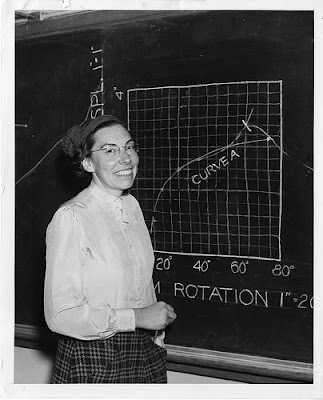
Image: Mary Blade, standing at blackboard
Description: In 1946, when this photograph was taken, Mary Blade was the only woman on the Cooper Union engineering faculty (where she initially taught drawing, mathematics and design) and one of few women on any engineering faculty in the United States. Blade was an avid and accomplished mountain climber.
Image: Cornelia Maria Clapp (1849-1934), sitting at desk
Description: Ichthyologist Cornelia Maria Clapp (1849-1934) earned both the first (Syracuse, 1889) and second (Chicago, 1896) biology doctorates awarded to women in the United States. She spent most of her career as professor of biology at Mount Holyoke College and, every summer, continued her research on fish development at the Marine Biological Laboratory at Woods Hole.

Go browse the whole set. And also check out the posts at The Bigger Picture by a couple of the archivists who helped assemble the Flickr collection: Mary Markey on "Adventures in the Morgue" and Ellen Alers on "Formidable: Women in Science".

(via ScienceWoman)

Tags: , ,

Thursday, March 19, 2009

Barbara Liskov wins the 2008 Turing Award

So, finally, back to regular blogging with an excellent award story.

Earlier this month MIT Ford Professor of Engineering Barbara Liskov has been named the winner of the 2008 A.M. Turing Award. The award is presented by the Association for the Computing Machinery to "an individual selected for contributions of a technical nature made to the computing community. And "the contributions should be of lasting and major technical importance to the computer field." It's often called the Nobel Prize in computing, which gives you a sense of the award's prestige.

In 1968 Liskov defended her dissertation - "A Program to Play Chess Endgames” - at Stanford University, becoming the first U.S. woman to earn a Ph.D. in computer science. She told the web site "Engineer Girl" that the expectation that she, as a woman, wasn't really pursuing a career allowed to to focus on research that interested her:

I didn't have a plan for where I was going; instead I reacted to obstacles and opportunities. I believe that some of this was due to being a woman. When I was young, it was uncommon for women to think about having a career. The effect on me was that I just focused on doing work that was interesting but expected to stop working when I had a family. I got into research in software systems and I realized that I was really committed to my work and would not give it up. Later when my husband and I had a family, I continued to work full time.
Listen to her interview on Talk of the Nation for more about how she ended up in computer science. She tells Ira Flatow that she didn't feel particularly lonely as the only woman in her (very small) Ph.D. program, and felt like she was accepted like everyone else when she joined the faculty at MIT.

She ended up doing pioneering research "creating and implementing programming languages, operating systems, and innovative systems designs that have advanced the state of the art of data abstraction, modularity, fault tolerance, persistence, and distributed computing systems." The Boston Globe explained the significance of her achievements in slightly less technical terms:
In particular, Liskov developed two programming languages, CLU in the 1970s and Argus in the 1980s, that formed the underpinnings for languages like Java and C++, commonly used to write software applications for personal computers and the Internet. As such, her work helped to form society's information infrastructure.
[. . .]
In the early days of computing, programs were written as long strings of numbers and characters known as code, sometimes broken up by chunks. Liskov's work helped pioneer what is known as object-oriented programming, now the most common approach to software development. She is credited for laying the groundwork for development of sophisticated programs tailored to financial, medical, and other consumer and business applications.
I especially like the idea that her work formed the underpinnings of the software that makes my laptop run and lets my post this very post.

Her current research focuses on distributed computer systems like the internet and security of online storage. In more technical terms:
Her most recent research focuses on techniques that enable a system to continue operating properly in the event of the failure of some of its components. Her work on practical Byzantine fault tolerance demonstrated that there were more efficient ways of dealing with arbitrary (Byzantine) failures than had been previously known. Her insights have helped build robust, fault-tolerant distributed systems that are resistant to errors and hacking. This research is likely to change the way distributed system designers think about providing reliable service on today's modern, vulnerable Internet.
Liskov is only the second woman to win the Turing award. Two years ago IBM Fellow Emerita Fraces E. Allen was the first.

More reading:
Tags: , ,

Wednesday, January 23, 2008

Women in Science: The view from 1957

One of the things I love about this internet age of ours is that venerable periodicals are opening their archives to the public. The latest is the Atlantic Monthly, which includes articles from 1995 to the present, plus a sampling of other articles from earlier years. In one of those early articles, published in October 1957, economist Helen Hill Miller looked at Science: Careers For Women. She found that the opportunities for women were opening up in the traditional male fields of science:

Only yesterday, women who entered such fields as science, engineering, medicine, were looked on as square pegs trying to force themselves into round holes where they weren't wanted and didn't fit. Not many married women worked outside their homes in any occupation, and teaching and nursing were regarded as the suitable means of self-support by spinsters.
[. . .]
Now about 5 per cent of the doctors of the country are women; about 10 per cent of the chemists; out a quarter of the biologists. Some of these are the knowledgeable, careful assistants – the Marthas of the laboratory – who free top men for work on the frontiers of science, but by no means all.
I find the phrase "Martha of the laboratory" a bit cringe-worthy – it makes me think of a mousy glasses-wearing woman who works long hours to keep the lab running while pining for the love of the eccentric and clueless Scientist who is too busy making Discoveries to notice her efficient work or hidden beauty (or maybe I've seen too many bad movies). Anyway, Miller goes on to point to Nobel-prize winning biochemist Dr. Gerty Cori, as well as Helen Sawyer Hogg, president of the Astronomical Society of Canada, professor Harriet Creighton, president of the Botanical Society of America, and Dr. Hoylande Young, head of the Chicago section of the American Chemical Society. At the time the article was written, six women had been admitted to the National Academy of Sciences.

While women in 1957 were still overtly discriminated against, they still had it easier than the women who had come before them:
Much of the time and energy of women who entered the scientific professions in the nineteenth century was spent in either contriving to take barriers gracefully or crashing into them with results demolishing sometimes the woman, sometimes the barrier. Eminent women now in retirement well remember where fences were located and where they were coming down when they entered training. [. . .] To many a pioneer who came up the hard way, the lot of the science majors of the class of 1957 who are entering advanced study or employment this autumn seems a very easy one.
"Easy" being a relative term. While women in science today, half a century later, have it easier than the graduating class of 1957, some things haven't changed much at all.
Other types of restriction remain. One is the counsel that many young girls get when making up their minds about entering a profession. Interviewed in his private machine shop among boulders and birches at Belmont, Massachusetts, Dr. Vannevar Bush credited folklore with much of the reluctance of women to attempt disciplines based on logic, such as mathematics and physics. Promising youngsters, he remarked, are frequently scared off by the declaration: "Girls aren't good at math." Some girls, he believes, can be very good at it. Dean Gordon B. Carson of Ohio State's College of Engineering concurs: "There is still some social stigma and question in the high schools of the nation when girls major in the scientific-mathematics portion of the high school curriculum."
That paragraph could almost fit into an article published today. It just shows how entrenched the idea that "girls can't do math" is in our culture.

But the greatest barrier was a social one – the assumption that women will focus more time on her home life than on her career.
But the two-way stretch of a home and a job, during at least part of a married woman's life, is undeniable. To solve this highly personal problem without quitting requires finding an employing institution that can accommodate itself to maternity leave, part-time employment, sudden emergencies. It requires a family in accord with the effort. It requires finding, for at least part of the time when the children are young, another woman who can relieve the scientist of the necessity of being in two places at the same time. And it requires a certain philosophy, about scientific attainment: in today's competitive conditions, continuity of work is almost indispensable if one is to get as far as one might be able to go – as Vannevar Bush puts it, "Getting to the top on part time is doggone tough."
Note that Miller assumes a woman is needed for child care, and there is no mention of a husband that shares the responsibilities. And in this was in the midst of the post-war baby boom, with women marrying younger and planning more children than women had before the war. Miller goes on to describe how women balanced career and family life – by choosing more "flexible" specialties, by being part of a husband-wife team, or being a "lone wolf" like the brilliant, but unmarried, Barbara McClintock.

A lot has changed in the past fifty years. Certainly medical schools no longer limit women to 5% of the student body, and female astronomers can now use the telescopes at Mount Wilson and Mount Palomar. But the difficulties for women pursuing a career in science that Miller describes are mostly different in degree, not kind. Hopefully change will be faster over the next fifty years.

Related: io9 has tasty quotes about women scientists from 1950s issues of Seventeen, American Girl, and Woman's Home Companion, that praise their homemaking skills as highly as their scientific ones.

Tags:, ,

Wednesday, January 16, 2008

Women With Power Tools

The Library of Congress has started a Flickr account with freely available images from it's collection. To date there are only two categories, "1930s-1940s in color" and "News in the 1910s". The collection includes some great photos of women working as mechanics and machinists during WWII, a la Rosie the Riveter. Women who had previously been housewives or store clerks were trained for their new job. The pay was good, and many shipyards and other facilities provided child care. When the war was over and the men returned home, many of the women who worked for the war effort went back to being housewives or found new jobs at much lower pay.

Some were inspired to further their education, like Susan Taylor King. From her reminiscences:

After 10 months of work at Eastern Aircraft, I decided to enter college. I felt strongly that there must be a way to help my community. I entered college and later received my Bachelor of Science and my Masters Degrees from Morgan state University in Baltimore , Maryland . My career continued after riveting and I worked in the Baltimore City Public School System as a science teacher and a guidance counselor.
Read more of their stories.

Tags: , ,

From the LoC Flickr collection:

Operating a hand drill at Vultee-Nashville, woman is working on a "Vengeance" dive bomber, Tennessee (LOC)
Originally uploaded by The Library of Congress

Thursday, January 10, 2008

New US Postage Stamp Honoring Scientist Gerty Cori

In April the U.S. Postal Service will release a new series of stamps honoring 20th Century American scientists. One of the first four stamps to be released depicts Gerty Cori. In 1947 she became the first woman in America to receive the Nobel Prize (along with her husband Carl Ferdinand Cori and Argentine physiologist Bernardo Houssay) for discovering how glycogen (a form of stored energy in animals) is broken down into sugar, then turned back into glycogen.

It took years for Cori to be acknowledged for her research:

The Coris decided to leave Roswell soon after publishing their work on carbohydrate metabolism, mainly because Roswell's primary focus was cancer research. But though they had developed the Cori cycle together, Carl Cori was the one to receive job offers at universities. Although faculty at the University of Rochester warned Gerty Cori that she might ruin her husband's career, the couple refused to stop working together. Both Cornell University and the University of Toronto refused to hire Gerty Cori even while they tried to persuade her husband to take up an appointment, so the couple moved to St. Louis in 1931, where Carl had been offered the chair of the pharmacology department at Washington University School of Medicine. Gerty Cori was offered a position as a research assistant, despite her partnership role in the discovery of the Cori cycle.
It was only after Carl Cori was made chair of the department, 16 years after their arrival, that Gerty Cori was promoted from research assistant to full professor. The following year they won the Nobel prize. It's yet another example of an accomplished female scientist who was only given a research position because a close relative (in this case her husband) fought for it.

This is the second set of stamps honoring US Scientists to be released. The first set included geneticist Barbara McClintock.

(via Wired Science)

Tags: , , ,

Wednesday, January 09, 2008

Invisible Computers


I'm a computer user, not a programmer, and I'm rather fuzzy on the history of computers. However, I have heard of ENIAC, which, as Wikipedia puts it, was "the first purely electronic, Turing-complete, digital computer capable of being reprogrammed to solve a full range of computing problems". It was constructed during World War II at the University of Pennsylvania. It was a behemoth compared to the laptop I'm using at the moment.

It contained 17,468 vacuum tubes, 7,200 crystal diodes, 1,500 relays, 70,000 resistors, 10,000 capacitors and around 5 million hand-soldered joints. It weighed 30 short tons (27 t), was roughly 8.5 feet by 3 feet by 80 feet (2.6 m by 0.9 m by 26 m), took up 680 square feet (63 m²), and consumed 150 kW of power. Input was possible from an IBM card reader, while an IBM card punch was used for output.
It's hard to imagine operating such a machine, let alone programing it. The trouble back then was that male mathematicians were scarce due the war, so they had to turn to women to get the job done. A team of six young women were the first ENIAC programmers, but their contribution has been largely forgotten. From a recent ABC News report:

At 83, Betty Jean Jennings Bartik -- a devoted bridge player and grandmother of five -- had a secret past that was invisible to many who knew her.

Her grandson Alex knew her story. He stormed out of school one day when his teacher refused to believe his gray-haired granny was a computer pioneer who had calculated firing tables and ballistic trajectories during World War II.

The boy's parents had to explain to the teacher that Bartik and five other women had, indeed, legally hacked the world's first programmable computer, converting it into a stored machine and eventually helping to usher in the digital age.

"She was dumbfounded," said Bartik.

So, too, were the historians, who for a half century never acknowledged the wartime contributions of the six women who programmed the Electronic Numerical Integrator and Computer (ENIAC) and made programming easier and more accessible to those who followed.

The team included:

  • Kathleen McNulty Mauchly Antonelli had a degree in math from Chestnut Hill College for Women in Philadelphia. Antonelli married ENIAC co-inventor John Mauchly, resigning her post at the Aberdeen Proving Grounds Ballistics Research Laboratory. In the 1980s she wrote articles and gave talks about her experience. In 2005 Antonelli and good friend and co-programmer Bartik talked about their experiences at WITI New York, which you can watch online. She died in 2006.
  • Jean Jennings Bartik had a degree in math from Northwest Missouri State Teachers College. After working on ENIAC, she went on to work on the BINAC and UNIVAC I computers. Northwest Missouri State University honored her achievements by naming their computing museum after her. In 2005 Bartik and Antonelli talked about their experiences at WITI New York, which you can watch online.
  • Betty Snyder Holberton studied English and journalism at the University of Pennsylvania, but was apparently a natural at programming. From Wikipedia:
    She was the inventor of the mnemonic instruction set (called C-10) for the BINAC, which Grace Hopper described as "the basis for all subsequent programming languages." It has been said that in creating this, she started the movement away from switch assemblies and towards keyboards as the primary input device for computers. She also wrote the first generative programming system (SORT/MERGE), and the first statistical analysis package (for the 1950 US Census). She participated in the early standards development for the COBOL and Fortran programming languages.
    In 1997 she received the Ada Lovelace award for her achievements in programming. She died in 2001.
  • Marlyn Wescoff Meltzer studied something(?) at Temple University. She left the ENIAC project in 1947 to get married.
  • Frances Bilas Spence majored in math and minored in physics at Chestnut Hill College. In 1947 she married Homer Spence, an electrical engineer assigned to the project, and she resigned to raise a family.
  • Ruth Lichterman Teitelbaum had a bachelor's degree in math from Hunter College. She traveled with the ENIAC project when it moved to the Ballistic Research Laboratory at the Aberdeen Proving Grounds and helped train the next group of ENIAC programmers. She died in 1986.

Shockingly, the only one of the six initially invited to the ENIAC 40th anniversary celebration at the University of Pennsylvania was Kathleen McNulty Mauchly, and then only as the wife of inventor John Mauchly. How could this group of women have been forgotten for so long? As Wired noted in 1997, when they were inducted into the Women in Techonology International Hall of Fame:

But although they were skilled mathematicians and logicians, the women were classified as "sub-professionals" presumably due to their gender and as a cost-saving device, and never got the credit due to them for their groundbreaking work.

"Somebody else stood up and took credit at the time, and no one looked back," explains Anna van Raaphorst-Johnson, a director of WITI. "It's a typical problem in a male-dominated industry. And there's still a lot of frustration with men taking credit for women's ideas - it doesn't seem to have changed much over the last 50 years."

Kathy Kleiman, a former programmer herself, is trying to rectify that. Kleiman, along with Academy Award-winning documentary maker Susan Hadary and head of the University of Maryland's Center for Women in Information Technology Claudia Morrell, is producing a documentary on these six women titled "Invisible Computers: The Story of the ENIAC Programmers".

As ABC News reported, Kleiman began her interest in the ENIAC programmers when she was a Harvard undergraduate.

While reading a biography of an Army captain who found funding for ENIAC, Kleiman discovered a 1940s photo of women at a 9-foot tall computer. A computer historian told her those were "just refrigerator ladies" who had been posed in front of the machine "to make it look good."

"They looked knowledgeable to me, and I made it my job to track them down," said Kleiman.

She has since spent years collecting oral histories and hopes that the documentary will help keep their story from being forgotten. Stories like this are important, not only so an important part of our technological history is not forgotten, but as a rebuttal to those who claim that women don't go into computer science or mathematics simply because they aren't interested. If you'd like to help, you can make a donation to help support the production ENIAC programmers documentary.

On that note, Aunt B. at Tiny Cat Pants is asking for stories about womens' experiences in mathematics and computer science. It's in response to a commenter who claims that the reason for the gender gap in computer science is simply that "not as many women wanted to be computer scientists as men". Her commenters have already responded with a number of interesting (and maddening) personal stories.

ETA: Did you comment at Tiny Cat Pants? Science writer Jennifer Ouellette is wondering if she can include your story in a book she's writing about women and math.

Image: "Two women operating the ENIAC's main control panel while the machine was still located at the Moore School. "U.S. Army Photo" from the archives of the ARL Technical Library. Left: Betty Jennings (Mrs. Bryant) Right: Frances Bilas (Mrs. Spence)"

Tags: , , , , , , , , ,

Wednesday, August 15, 2007

Priscilla Reining, ~1923-2007

The Washington Post writes about the life and research of anthropologist Priscilla Reining who died on July 19 at the age of 84.

She was a distinguished scientist who held three degrees in anthropology from the University of Chicago, but she was also, according to those who knew her, a courageous and groundbreaking example to other women.

In 1953, she moved to Tanzania with her infant son, the first of her three children, and lived near a Haya village for two years. At the same time, her husband, Conrad C. Reining, was conducting research in Sudan.

They fled a Sudanese uprising in 1955.

"We were lucky to escape," Robert Reining said. "My father knew a back road out of Sudan into Congo. He led a whole convoy of people, and they escaped."

In the 1970s, Reining spearheaded an African satellite mapping project.

Robert Reining took a year off from college in the mid-1970s to help his mother on an early satellite mapping project. Whole regions of Africa suddenly came into view. Scientists could measure the advance of the Sahara Desert, and governments and lending agencies could plan drought and famine relief.

"These were the first images available to anyone outside the intelligence community," said her son. "For the first time, we could count the villages. You had what was effectively the first reliable population estimate of this area."

Reining is best known for her analysis of patterns of HIV infection in different African populations which found that uncircumcised African men were 86% more likely to get infected with the AIDS virus. Not surprisingly, her results were met with skepticism, but subsequent studies have confirmed the correlation.
But finally, at an international AIDS conference in Sydney last week, Anthony S. Fauci, director of the National Institute of Allergy and Infectious Diseases, declared, "We've had one important breakthrough this year, with understanding the role of circumcision in prevention."
Tags: , ,

Monday, July 16, 2007

Sisters in Science

Diverse ("Issues in Higher Education") has republished a 1998 article about African-American women in science. At the time significantly more African-American women were enrolled in institutions of higher education than African-American men, but that difference was much narrower in the sciences and engineering.

Is it simple propensity that has more Black women seeking degrees in education, the social sciences, and the health professions, or are sisters being subtly guided away from the sciences and into more "typically female" fields? Given the fact that African American women receive five bachelor's degrees for every three that men earn, why do they receive just two undergraduate engineering degrees for every three that men earn?
The article points out that the lack of African-American women in the sciences may have had a negative impact on research in some fields.

While race and gender should not necessarily dictate areas of research, the paucity of African American women scientists has clear implications. There have not been studies, for example, of the impact that crack has on African American women. We see rising incarceration levels among Black women -- with a 500 percent increase in the past decade -- largely because of drug use and addiction. We also hear anecdotal evidence of crack's "hold" on Black women. But there has been little done to explain this more fully.

Similarly, although African American women seem to be more likely to be diagnosed with breast cancer -- and in many cases, to be diagnosed earlier -- there have not been scientific explanations for this phenomenon. Studies on the health status of women have just garnered attention in the past decade, but studies on the health status of African American women are few and far between.

Has much changed in the last nine years? A NSF report looked at minority undergraduate science and engineering students from 1995-2004 found that there was an increase in science and engineering degrees awarded to black students during that period, particularly in computer science. However, the data isn't presented as a percentage, so it's not clear to me whether the percentage has increased.

Women's actually crunched some of the numbers in a February 2006 article about black women in science:

Data collected by the National Science Foundation, an independent federal agency in Arlington, Va., found that of the 7,488 science doctorates awarded to all Americans in 2004, just 124--or 1.7 percent--were awarded to black women compared with 2,274 doctorates--or 30 percent--for white women. In engineering, a total of 1,941 doctorates were awarded in 2004. Of those, only 32--or 1.7 percent--were conferred on black women and 296--or 15 percent--went to white women. African Americans make up 12 percent of the U.S. population.

Even fewer women of color are finding their way into academia. According to a 2004 survey by Donna Nelson, a chemistry professor at the University of Oklahoma, the percentage of women among full professors in science and engineering ranges from 3 percent to 15 percent. Of these, there are only a few African American women in science and engineering departments; there are no black female tenured or tenure-track professors in computer science. (Nelson was named this year by Women's eNews as one of its 21 Leaders for the 21st Century 2006 for her research quantifying female representation in science.)

While women in general are underrepresented in science and engineering, black women have even less of a presence in those fields. The book Sisters in Science: Conversations with Black Women Scientists on Race, Gender, and Their Passion for Science, by Diann Jordan profiles 18 of those women, including:
  • Yvonne Clark: the first black woman to be awarded a B.S. in mechanical engineering. According to her IEEE profile:
    Recently, Clark received a grant from the Department of Energy to lead a team of scientists on a research project for improving refrigeration. She has also served as the student division team leader for the NASA-funded Center for Automated Space Science at Tennessee State University (TSU), where she continues to teach today. Her prolific career has included a number of awards and honors, including recognition from Howard University for outstanding achievement in engineering, and for leadership and distinguished service by the Society of Women Engineers. In the nearly forty years she has spent at TSU, the number of women in the engineering fields at the University has risen from only herself in the mid-1950´s, to approximately one in four today, an increase that is surely due in part to her example.
  • Georgia Dunston: currently Chair of the Department of Microbiology and Founding Director of the National Human Genome Center at Howard University. Under Dunston's leadership, the university established the Genomic Research in the African Diaspora to study genetic factors in diseases that disproportionately affect people with African ancestry.
  • Shirley Jackson: physicist and president of Rensselaer Polytechnic Institute. According to her official profile:
    Dr. Jackson is the first African-American woman to receive a doctorate from M.I.T. — in any subject. She is one of the first two African-American women to receive a doctorate in physics in the U.S. She is the first African-American to become a Commissioner of the U.S. Nuclear Regulatory Commission. She is both the first woman and the first African-American to serve as the chairman of the U.S. Nuclear Regulatory Commission, and the first African-American woman to lead a national research university. She also is the first African-American woman elected to the National Academy of Engineering, and the first to receive the Vannevar Bush award.
Diann Jordan is herself a scientist: she is an full professor of Biology at Alabama State. Like many black women in science, she has many firsts in her resume.
She was the first woman faculty ever hired in the Soil and Atmospheric Sciences Department, first African American woman tenured in a science department at the University of Missouri-Columbia (1996) and the first African American woman to earn a Ph.D. in Soil Science at Michigan State University in 1987.
Hopefully in another 10 years more progress will be made to close the gap in both race and gender in the sciences.

Tags: , , , ,