Showing posts with label stereotypes. Show all posts

Saturday, March 21, 2009

Depictions of 20th Century Women in Science: The Smithsonian Collection

There's an interesting post on the National Museum of American History's blog by Arthur Molella about the way women are portrayed interacting with technology and science in 20th century photographs. Molella has focused on the images in the Smithsonian's Science Service Historical Image Collection, which distributed photographs to mainstream media outlets such as newspapers and magazines. One thing he noticed was that the women rarely appeared to be actively involved in scientific pursuits:

While there are literally hundreds of photographs of white-coated male researchers making or using scientific instruments, there are almost none of women doing comparable things. Rather, women are invariably passive or admiring observers. In other words, females are shown dominated by rather than in charge of technology.

Science Service images were typical of those presented by other contemporary media, save for the occasional movie about Madame Curie. None of this means, of course, that women did not play active roles in science and technology over the last two centuries. On the contrary, at the Lemelson Center we have uncovered ample evidence of significant female contributions. But, given the skewed nature of the visual record, we have had to work very hard to find this evidence. While image isn’t everything, it counts for a lot in today’s visual culture.

But that's not the end of the story. At The Bigger Picture, the Smithsonian's photography blog, Effie Kapsalis of the Smithsonian Photography Initiative was a bit surprised by Molella's observations, so did a little digging and discovered that the :
After giving a call over to [Smithsonian Institution Archives], I found out that when the Science Service records were transferred to the Smithsonian during the 1970s (over 500 boxes!), records were distributed throughout SI depending on their relevancy to a museum’s expertise and mission. So, for example, any material dealing with the history electrical innovation and invention went to the Division of Electricity and Modern Physics at what was then named the National Museum of History and Technology (now NMAH). Other parts of the Science Service records followed, going to other NMAH curatorial divisions, the Smithsonian’s National Air and Space Museum, National Museum of Natural History, National Portrait Gallery, and the Smithsonian Institution Archives. The women in the photos at the Lemelson Center indeed look more like early 20th century Vanna White’s then the women in the SIA records.
So the photos of actual women scientists were there in the initial collection. It does make me curious as to which images media outlets chose to run, but at least they had the option of choosing photos of women who weren't just admiring their reflections in the shiny equipment. (And as a side note, I think this exchange really exemplifies one of the advantages that news on the web has over news in the print media. If Molella's post had been a sidebar in a magazine, I likely wouldn't have seen the rest of the story.)

Kapsalis was familiar with the full extent of the Smithsonian's photo collection because they've been posting some amazing images of women in science on Flickr in honor of Women's History Month. Here's the collection's description:
Throughout March 2009, SIA will post groups of photographs showing women scientists and engineers at work; women trained in science and engineering who worked outside the laboratory as librarians, writers, political activists, or in other areas where their work informed or was informed by science; family research collaborators who assisted their scientist husbands and fathers; and several images for which we have little descriptive information to which we invite you to contribute!
There are images of physcist Katharine Burr Bodgett (1989-1979), botanist Mary Agnes Chase (1869-1963), herpetologist Doris Mable Cochran (1898-1968), neuroanatomist Elizabeth Caroline Crosby (1888-1983), astronomer Annie Jump Cannon (1863-1941), biologist Muriel A. Case (1901-1981), geneticist Estrella Eleanor Carothers (1883-1957), biochemist Mary Van Renssalaer Buell (1893-1969), physiologist Elizabeth M. Bright (at Harvard Medical School in the 1920s), and physicist Maria Goeppert-Meyer dressed to the nines and being escorted by King Gustav Adolf of Sweden at the 1963 Nobel Prize banquet (she looks understandably a bit stunned). As the description of the set suggests, not every photo is of a scientist, there's also test pilot Jacqueline Cochran, nurse Josephine Fountain (inventor of the "Direct Suction Tracheotomy Tube"), and science journalist Marjorie MacDill Breit, among many others.

It's so nice to see that the set is not at all dominated by the most well-known women scientists, like Marie Curie. It is interesting, though, that few of the women are wearing white lab coats or other "typical" laboratory or field gear. I've seen scientists having their photos taken for publicity shots and I know the photographer often ends up making the setting quite artificial (PI in pristine lab coat holding up a sequencing gel or other film while artfully arranged reagent bottles sparkle in the background seemed to be a popular one), so it's hard to know how representative they are of what these women usually dressed when they were working. Most look like they are enjoying themselves, though, and I think that's all natural.

Here are a few I especially liked - some as much for their descriptions as the images.

Image: Wanda Margarite Kirkbride Farr (b. 1895) sitting lab with microscope
Description: Wanda Margarite Kirkbride (b. 1895) was completing graduate work in chemistry at Columbia University when she met and married Clifford Harrison Farr. When Clifford died in 1928, while they were living in St. Louis, Wanda Farr carried on with her research and eventually became Director of the Cellulose Laboratories at the Boyce Thompson Institute for Plant Research in Yonkers, New York, doing pioneering work on cellulose synthesis and plastids.
(I wonder if the spiffy hat was part of her usual lab attire. I suspect not.)

Image: Mary Blade, standing at blackboard
Description: In 1946, when this photograph was taken, Mary Blade was the only woman on the Cooper Union engineering faculty (where she initially taught drawing, mathematics and design) and one of few women on any engineering faculty in the United States. Blade was an avid and accomplished mountain climber.
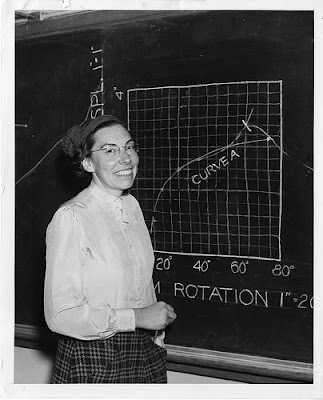
Image: Cornelia Maria Clapp (1849-1934), sitting at desk
Description: Ichthyologist Cornelia Maria Clapp (1849-1934) earned both the first (Syracuse, 1889) and second (Chicago, 1896) biology doctorates awarded to women in the United States. She spent most of her career as professor of biology at Mount Holyoke College and, every summer, continued her research on fish development at the Marine Biological Laboratory at Woods Hole.

Go browse the whole set. And also check out the posts at The Bigger Picture by a couple of the archivists who helped assemble the Flickr collection: Mary Markey on "Adventures in the Morgue" and Ellen Alers on "Formidable: Women in Science".

(via ScienceWoman)

Tags: , ,

Tuesday, January 13, 2009

Hina Chaudhry: Interesting Science from a Lab-Worn Doctor-Lady

Over on my Biology in Science Fiction blog I recently posted about an article by Tom Junod in men's magazine Esquire profiling UW scientist Mark Roth. The article was bad, in part because it painted a picture of Roth as an genius maverick who couldn't get a grants because his ideas were too brilliant, unlike the plodding never-had-a-fresh-idea scientists actually funded by the NIH. But it wasn't just that. It was the writing, which read like a transcribed conversation with a valley dude who was completely unfamiliar with science and the way it's practiced.

Now Carl Zimmer points out another article in the latest Esquire - this one by Lisa Taddeo - that's equally bad. There's the flip conversational tone and use of odd analogies*, and, as a bonus, "who'd believe this normal-looking woman is a scientist."

But now look here, a woman. She is a pretty lady of Pakistani heritage who highlights her soccer-mom layers, which you don't expect from a lab-worn doctor-lady. And she's got ideas. Wild ones. Hina Chaudhry believes she can do what the body can't: fix the dead parts.
Highlighted layers and ideas? Amazing! And is the "soccer-mom" description a dig at her style?

It's a shame the writing is so bad, since Chaudhry's research sounds quite interesting. She's been studying the role of the cell-cycle regulating protein cyclin A2 in heart development.

From the Esquire article:
Chaudhry says it was women's intuition. The holy-shit solution. It came to her during a seminar at UPenn when she was twenty-nine. They were discussing fruit-fly genes. How the head segment knows it's going to form a head and how the tail segment knows it's going to be a tail. "I just had this sudden realization that heart cells don't divide after birth in any mammal. They divide in the embryo, but they stop after birth," she says. "So I thought, That's it! We have to go back and study the basics of why and when heart cells stop dividing." If they could do that -- figure out what causes heart-cell division to turn off -- then perhaps they could find a way to turn it back on.
She's devised a method of introducing an expressed version of cyclin A2 into adult heart cells, which appears to allow the heart to recover from a heart attack. It's been successfully tested in rats and ultimately she hopes that the method can be used in humans.
Her idea was laughed at, at first. In part because she was young and a woman, she says. But now the medical world is sitting up, taking notes.

Chaudhry was recruited to Mount Sinai's Cardiovascular Institute by the director of Mount Sinai Heart, Dr. Valentin Fuster, and the medical center's Cardiovascular Research Center director, Dr. Roger Hajjar. She calls them the two greatest visionaries in the cardiac world. Along with their chosen one, this bright many-schooled angel, they are going to make Mount Sinai the leading thinker in the heart world. "We've had no therapies to reverse heart failure, to make a diseased heart normal again," says Hajjar. "This therapy may finally do that."

An angel and "chosen one" - that's a lot to live up to. Heart attacks are a top killer here in the United States, so anything that improves the survival rate would be a significant achievement. I suspect, though, that Chaudhry's methodology is further from being a clinical reality than the article might lead you to believe.
---

* From the description of what happens during a heart attack.
"Suddenly, soldier, this part of your heart is dead, only it's still in your body, attached to the good section -- the 90210 ventricle -- and the good part is smirking, it's saying, "Come on, rebuild yourself, man!"
Science articles rarely
juxtapose a reference to a teen drama and a quote from an anthropomorphized internal organ in the same sentence (not to mention the gratuitous "soldier" reference), so this is very special.

Tags: ,

Monday, January 12, 2009

Women in Science Link Roundup: January 12 Edition

Between the holidays, getting ready for ScienceOnline09, and reading Anathem (which will probably result in a post) I've really gotten behind in posting here. I've also been spending a lot of time reading other people's posts. I don't know if it's because people had a bit of vacation, or have been thinking about the past year, or just chance, but there seem to have been a lot of interesting discussions over the past few weeks.

I've included brief excerpts below to give you the sense of posts, but I really recommend following the links to read both the posts and the comments.

Blue Lab Coats: Is it unfair to have women's faculty groups?

Many of us women don’t have a female science next door neighbor, or even another female TT department-mate, who might understand our unique issues and teach us how to function effectively in a male-dominated environment. If we did, having a group where we could get the support and mentoring we need from people with like experiences to help us climb the academic ladder successfully, wouldn’t be such a pressing issue.

A Blog Around the Clock: The Shock Value of Science Blogs
Academic science is a very hierarchical structure in which one climbs up the ladder by following some very exact steps. Yes, you can come into it from the outside, class-wise, but you have to start from the bottom and follow those steps "to the T" if you are to succeed. But those formal steps were designed by Victorian gentlemen scientists, thus following those steps turns one into a present-time Victorian gentleman scientist. But not everyone can or wants to do this, yet some people who refuse are just as good as scientists as the folks inside the club. If you refuse to dance the kabuki, you will be forever kept outside the Gate. The importance of mastery of kabuki in one's rise through the hierarchy also means that some people get to the top due to their skills at glad-handling the superiors and putting down the competitors with formalized language, not the quality of their research or creativity of their thought.
And there's a lot more food for thought on his post.

Not Exactly Rocket Science: Why are there so few female chess grandmasters?
You should read the whole post, but here's Ed's conclusion:
So why are there so few female chess grandmasters? Because fewer women play chess. It's that simple. This overlooked fact accounts for so much of the observable differences that other possible explanations, be they biological, cultural or environmental, are just fighting for scraps at the table. In science and engineering, where men dominate the top ranks but also have an advantage in numbers, it's likely that the same explanation applies, rather than the innate differences cited by Summers and Irwing.
Dr. Isis: "On Motherhood and Maintaining Your Identity..."
I felt like I was living a double life and constantly denying one half of my identity -- turning parts of myself on and off and disguising the others so that people only saw what I allowed them to see -- was emotionally draining and it left me feeling isolated in every sphere I interacted in. It left me feeling guilty when I let one part of my life creep into the other and it left me feeling depressed that I could not recognize my full identity for fear of being shunned in either sphere. I realized that I would not be able continue to function this way and be successful in either sphere. And with that, I opened the dam between the two spheres and have allowed them to blend together.
Greg Laden: The natural basis for gender inequality
This is a thought-provoking look at naturalism, primate behavior, and how it might relate to gender inequality in humans. The comments get a bit heated - or at least one dude does.

Courtney at Feministing points to a piece about Caroline Kennedy and the definition of "experience" in the New York Times.
She goes on to talk about how work "experience" used to be defined, visually speaking, as a ladder. Just keep on climbing and hope for the rewards on your way up. But a new paradigm is taking over, one that looks less like a ladder and more like a "lattice"--a shape that allows for stepping off and stepping back on, caretaking for children and aging parents, working non-traditional hours, taking detours into various fields, developing various skills etc. In this paradigm, success would be less defined by one's years of experience or status within a particular linear framework, but the quality of one's work, the breadth of one's experience, one's capacity for reinvention and adaptation.
Lee Kottner @ Cocktail Party Physics: by invitation only
This is quite a rant that compares the sexism in Christianity with the sexism in science, then takes on Dawkins' selection of writers for the Oxford Book of Modern Science Writing. I can't do it justice by taking a snippet, so just go read her post.

DN Lee @ Urban Science Adventures: Increasing Diversity in the Sciences With Mentorship and Conference Attendance
Scientific meetings offer tremendous learning and networking opportunities for students. This is especially true for students who are members of traditionally under-represented groups. Though you may be one of a few brown or young or feminine faces at the conference, many societies are working hard to get you at that meeting and to keep you coming back.
Female Science Professor: Just Call Me F
As a PhD and/or an academic, how do you like to be addressed?
Dr. Isis (who has been blogging up a storm the past few weeks) also weighs in: That's "Dr. Little Missy to You!

Young Female Scientist: science vs. street smarts in academia
Supposedly, your level of street smarts has more to do with your upbringing than almost any other single factor. People who know how to come in and play the system usually learned those skills early on, from their parents. Or maybe if they did certain activities after school.

This is a critical skill, but you don't learn these things in class.

However, here's where things get really interesting for women in particular.From what I can tell, street knowledge is really hard for women to get.
Christina Pikas posted the slides from her presentation at the IEEE Fourth International Conference on eScience. She looked at how science blogs were interconnected, and was able to identify subgroups in different scientific specialities and was even able to pick out a troll. She also found a high level of connectedness between women's science blogs:
What was interesting - and most definitely worthy of further investigation - is this cluster of blogs written mostly by women, discussing the scientific life, etc. The degree distribution was much closer to uniform within the cluster, and there were many comment links between all of the nodes. This, to me, indicates other uses for the blogs and perhaps a real community (or Blanchard's virtual settlement).
Juniper Shoemaker lays bare her long journey from English to genetics: part 1, part 2, part 3. English majors can indeed make great scientists.

Astarte's Circus: At Ease With Her Age
Most of Octogalore's post isn't about women in science directly, but discusses women and aging and appearance. And this part is directly relevant:
My aunt, who got into Harvard Med, wanted to be a doctor. My father, who also did, wanted to be a teacher. She was told “don’t BE a doctor. Marry a doctor.” He was told that literature was effete and that he would not continue to get love and admiration if he didn’t pursue the medical route. When he fainted at a gory video and had to be taken from the room, of course, it was clear things were a bit off.

He is now still teaching at 73, and still making much less than a first-year lawyer, but loves what he does. My aunt never did enjoy humanities and ultimately stopped working. When her kids left the home, she found herself at loose ends, with the fields she was most interested in having high entrance costs for a middle-aged woman who’d been out of the work force for twenty years.
GirlPostDoc wrote about "Marginalization and the fight for even less funding"
So should you be "extra careful of to avoid being marginalized?" No. Because that will happen anyway. If being the department's "Black or Brown Female Scientist" means that you have the chance to be present and give others a chance to see themselves where you are - I say go for it. Be that "Scientist." Be strong, take lots of deep breaths, and always be humble. And know that you are not alone.
There were also posts about stereotypical feminine gender roles and being a scientist or engineer by Green Gabro, Dr. Isis, Leslie Madsen Brooks, Sheril Kirshenbaum ....

Last, but not least, is this old post of Zuska's: "Explaining (Away) Women Geeks". Of particular note is this comment by Mark Chu-Carroll about affirmative action. (Thanks to commenter SKM in this discussion of affirmative action and gender at Shakesville)

Tags: , ,

Sunday, December 21, 2008

Women in Science Link Roundup: December 21 Edition

Some of women in science-related blog posts and articles I've been reading the past few weeks, but never got around to blogging:

Life as a Woman Scientist

There have been a bunch of interesting posts at the Praxis "academic life" blog carnival. Both Praxis #4 at The Lay Scientist and Praxis #5 at Effortless Incitement include links discussing women in science.

Several recent posts at Inside Higher Ed's Mama, PhD blog have generated a lively blog discussion.

Ambivalent Academic brings up a usually taboo subject: the role of our hormonal cycles in the way we work and lead. There are a lot of personal stories and other discussion in the comments.

Bios and Awards

FGJ at the Feministing Community lists women in math and science she looks up to, and asks commenters to talk about their own favorite women scientists.

Ellen Kullman was named CEO of chemical giant DuPont. She is the first woman to lead a major public US chemical firm (via Jenn at Fairer Science).

The November HHMI Bulletin profiles biochemist Judith Kimble

The New York Times interviewed Renee Reijo Pera, professor of obstetrics and gynechology and director of Stanford's Center for Human Embryonic Stem Cell Research and Education


Stereotypes

Draw-A-Scientist Test: from seventh graders visiting Fermilab to adults in New York City's Madison Square Park, scientists are white and male.

Vince LiCata: "When Britney Spears Comes to My Lab"

In case you missed last month's discussion about women scientists, femininity and the double standard, you should read these posts and their comments:
Sadie at Jezebel found a picture of a good old-fashioned "Lab Technician Set For Girls"

Gender Gap

ScienceWoman has a list of ways to recruit women and minorities in a faculty search, and opens the comments to suggestions.

DrugMonkey rounds up the posts on the latest lack-of-gender-diversity-in-science discussion to make the blog rounds. There are also comments on those post, lots and lots of comments.

New York Times: What has driven women out of computer science?

Jenn @ FairerScience: Women and the Video Game Industry

FemaleScienceProfessor: Scientifiques avec Quelques Frontiéres (conference literature translated from French that states scientists are men), More Diverse Award Issues,

Mind Hacks: Shaking the foundations of the hidden bias test

Ilyka at Off Our Pedestals: Gosh, you ladies sure are touchy about Larry Summers! Or: Still assy after all these years

Feministing: The under-representation of female cardiologists

Fictional Women in STEM

The LA Times looked at the appeal of the characters on NCIS, including Pauley Perrette as forensic specialist Abby Sciuto. Perrett was working on her master's degree in criminal science when she decided to become a full-time actor.

Jessica Alba is currently filming An Invisible Sign of My Own:The film is a coming-of-age drama based on Aimee Bender's quirky novel about a 20-year-old loner named Mona Gray (Alba) who as a child turned to math for salvation after her father became ill. As an adult, Gray now teaches the subject and must help her students through their own crises.

In Frank Miller's movie adaptation of The Spirit, the character of Silken Floss has been "demoted" from nuclear physicist/surgeon to secretary. The original version too threatening perhaps? Hopefully she won't spend the whole movie pining for her boss.

Tags:

Tuesday, December 09, 2008

Open Laboratory 2008 Submissions

Bora at A Blog Around the Clock has links to all the submissions for the Open Laboratory 2008 science blogging anthology. The post entries will be judged and the top 50 will make it into the published anthology.

There are a number of women science bloggers who have entries, including:

Not only are there are lot of bloggers on the list, many bloggers submitted more than one post, so there are a huge number of entries. The judges have a tough job ahead of them.

Some of the entries relevant to women in STEM:
Tags: , ,

Saturday, November 15, 2008

Women in Science Roundup: November 15

Some interesting links I've collected over the past month or so:

ScienceWoman chronicles a day in her life as a 2nd year assistant professor with "an almost 2 year old": Part 1 (midnight - 8:39am), Part 2 (9:10am-5pm), Part 3 (5:20pm-midnight). ScienceWoman does not get much sleep!

There's a discussion at Dr. Isis's blog about whether (and how) women scientists should be allowed to "express their femininity". There are lots of comments (including mine), representing a wide range of opinions, from "I can't take feminine women seriously" to "I love being a girly girl" and lots in-between. And there is more discussion at ScientistMother, Candid Engineer, Professor Chaos, and Zuska's.

Asparagirl has a nice post at Metafilter about the women of ENIAC

James at The Island of Doubt writes about Alexandra Morton
, who has made significant contributions to marine biology without a PhD.

Jane Goodall was one of two winners of the Leakey Prize in human evolutionary science. She was also named a Glamour Magazine Woman of the Year.

Alice of Sciencewomen reported back from a day long Association of Women in Science workshop on "what works"

Nancy Jane Moore at Ambling Along the Aqueduct points to an essay in Bitch Magazine aon women and ambition.

ScienceWoman writes about pseudonymity in the "women in science" blogging community:

Also, the I think issue of trust is different in our community than in other parts of the science blog universe. Most of us are not using women-in-science blogs as a way of increasing our scientific knowledge. They are certainly no substitute for reading journal articles or time at the bench, field, or model. We are using women-in-science blogs to to learn from others, get tips on career development, cooking, paper-writing, and child-rearing. We are using women-in-science blogs to participate in a community of people who work in scientific/engineering fields and are interested in combining our demanding career with *some* sort of life outside the lab. And in this sort of community, it seems to be less important whether the blogger is Ariel, an astronomer in Arizona, than whether the blogger can provide insight into how to reach for the stars while keeping your feet on the ground. (And commenters too have such an important role in this community when you provide support, constructive criticism, sympathy, and encouragement).
Janet Stemwedel (aka Dr. Free-Ride) has some good reasons to blog under a pseudonym.

An article in Salon about "the momification" of Michelle Obama has inspired a great post by Kate about how family friendly workplaces are not only a woman's issue:
But here's the thing: making a workplace more family friendly is a fight that cannot be one by women alone. Women cannot be the only ones making a ruckus in the workplace and fighting with themselves, their peers and their bosses to effect change. If we make a nurturant woman's workplace more friendly but not her partner's, it means the woman is always being flexible, always ceding her own wishes, because it is more permissive in her workplace.
There's also discussion of the article at Geeky Mom.

A study of western anatomy textbooks used at European, American, and Canadian universities has shown - not surprisingly - that the "universal model" is a white male.
The researcher also points out that using female bodies to illustrate body parts that are identical in both sexes is a recent development. “Up until virtually the 1990s, male Caucasians were used exclusively to represent anatomical bodies, with female bodies appearing only in fragments to represent their sexual organs.”

Barral points out that these biased views persist, with an image appearing in the popular science magazine Mente y Cerebro as late as 2003 that made the female brain appear to come between that of a child and an adult male in the evolutionary process.

Lisa at Sociological Images shows a set of books for kids for sale at the NASA John Glenn Research Center that imply that "women scientists" are a separate category from simply "scientists". Would you buy a book for your daughter titled You Can Be a Woman Zoologist?

Valleywag notes that a recently touted milestone - more than half of Silicon Valley companies have at least one woman on the their board of directors - isn't really so great. That's actually still far less than the 89% of S&P 500 companies include at least one woman on their boards.

Tags: , ,

Thursday, October 23, 2008

Geniuses, Eccentrics and other Scientist Stereotypes

Astraea's Scales has an interesting post about the plethora of television shows that revolve around an eccentric genius who is almost inevitably male:

Shows that star women who are brilliant at what they do rarely portray them as the eccentric genius in a similar way. For example, compare the men above with Allison Dubois of Medium. Allison is easy to relate to, portrayed as "everywoman" who just happens to have a strange ability. Her talent and success aren't the result of genius, but of supernatural talent and stubbornness.

I don't know any other shows that are still running that feature a woman in a role similar to the shows above. I'm sure there must be others that I don't watch. But even going back to older shows, I can't think of any I've ever watched with a woman as the eccentric genius on par with the male characters.

[. . . ] The closest character I can think of is Jordan Cavanaugh of Crossing Jordan. Her impact, however, is dulled by the cast made up almost entirely of eccentrics, whereas the men are surrounded by smart but ordinary folks who have to deal with his strange brand of smarts. Women in those shows are sensible foils, or loyal supporters of the male genius.
An extreme example of what Astraea is talking about is Monk, in which brilliant detective Adrian Monk can barely take care of himself because of his obsessive-compulsive disorder and many phobias. He always has a female assistant who not only helps him solve crimes, but also drives him around, has hand wipes at the ready, and all the other things that Monk can't do for himself to make it through the day. It's hard to imagine the series with the gender roles reversed.

And the dramatic setup where the lead male character is an oddball genius and the lead female character is the sensible and responsible ones extends to dramas where the two characters are partners, rather than a boss and his assistant. A few examples:
  • X-Files: Special Agent Fox Mulder is the oddball who believes in UFOs and supernatural phenomena. Special Agent Dana Scully is a rationalist, who tries to find a scientific explanation.
  • Law & Order Criminal Intent: Detective Robert Goren is an intellectual who uses sometimes bizarre methods to get information and interrogate suspects. Detective Alexandra Eames is practical and usually does police work "by the book".
  • Fringe: Dr. Walter Bishop is the very eccentric and brilliant scientist. Special Agent Olivia Dunham is his minder and protector.
  • Eleventh Hour: Dr. Jacob Hood is the passionate genius science advisor. Special Agent Rachel Young is his protector.
While it's a good thing that women are often portrayed as competent and kick-ass law enforcement types, it would be nice if they could be eccentric geniuses too.

What does that have to do with women in science? Well, for one, such programs reinforce the stereotype of the lone male genius scientist. The perception in Western countries that scientists are male and white starts fairly young. For example, Sciencebase reports on a recent study of more than 4,000 children in Britain and Australia:
Most children’s sketches of scientists endowed them with a white, male face and the usual eccentric hair. Boys, Jarvis says, never drew women, and girls did so only very occasionally. While there may well be a minority of scientists who fit the category, it indicates a very narrow view of scientists, one that is so very often reinforced through TV programs and cartoons, comic books, and comments from nonscientist parents and other adults. We then wonder why so many girls and non-white children find it very difficult to envision themselves as future scientists.
The widely-used "Draw a Scientist Test" has been used for several decades to assess children's perceptions of scientists. In a study published by David Wade Chambers in 1983, only 28 of 4,807 drawings were of female scientists. I assume that the "occasional" drawings of women as scientists in the recent study were more frequent than that.

Do characters on television actually affect kids' perceptions of scientists? At least one small study suggests that exposure to women scientists on the crime forensics show CSI seemed to increase the likelihood that girls would depict female scientists. But even on CSI the head of the crime lab is (yes, you guessed it) an eccentric male.

So why do I think it matters? I think that TV roles reinforce the idea that while women can be competent scientists, they aren't likely to be creative geniuses. Of course that's not a stereotype unique to science; top artists, chefs, novelists, private detectives and historians are usually depicted as male as well. No one expects them to be nurturing or follow the rules.

I would love to see more female TV characters who are brilliant scientists with eccentric personalities and have male assistants, partners or spouses to take care of their mundane needs and responsibilities. And not just characters like Bones' Temperance Brennan, who is a genius with very poor social skills ("almost has Asperger's Syndrome" according to the creator), a point that's reinforced pretty much every episode I've seen. I want to see characters that are like NCIS's Abby (image above), who is unapologetically geeky and smart, has her own quirky style, and an interesting social life. All she needs is a lab - and a show - of her own.

Tags: ,

Saturday, August 09, 2008

It all started with the 19th Amendment . . .

I was looking for information about the 1955 B-Movie Tarantula, and came across this review. It turns out the "line to listen for" is

“I knew it would happen. Give women the vote and what do you get? Lady scientists.”
Of course, why didn't I think of that! Maybe the election year voter drives will increase the number of women physics professors . . . Actually I think it would be pretty funny in a "look how stupidly sexist it used to be the 1950s" way if there weren't individuals currently bemoaning both the terrible effects of women voting and working as scientists.

Anyway, if you are interested in seeing Tarantula in a science-friendly environment - and you live in Southern California - you might want to check out tomorrow's showing as part of the B Movies and Bad Science series at the Natural History Museum of Los Angeles County.

And here are some links I've been collecting about the way women scientists are portrayed in film and television that I hadn't gotten around to blogging about:
  • Inkling Magazine: Babe Scientists on Film
    "For best results in science, wear short shorts. And be sure your deep intellect is matched by deep cleavage."
  • Science and Supermodels: Female Scientists in Movies: The Top 10
    "We have to make a choice in a lot of cases; great women or great science. Sometimes we get both but that’s rare."
  • io9: Television: Meet the New Science Heroes
    This is about the portrayal of scientists on TV in general, but there is at least one woman scientist who will be on-screen in the fall lineup: Deanna Russo as super-scientist Sarah Graiman on the new version of Knight Rider.
Image: John Agar as small town physician Matt Hastings and Mara Corday as scientist Stephanie "Steve" Clayton in Tarantula.

Tags: , ,

Saturday, August 02, 2008

Women in Science Link Roundup: August 2 Edition

Here's a bit of what I've been reading the past few weeks, in no particular order:

Martin @ The Lay Scientist is starting a new blog carnival tentatively titled "Carnival of Scientific Life". He wants feedback, so go check out his post. (via Coturnix)

Jake Young at Pure Pedantry looks the variance in boys and girls' math scores in the recent report by Hyde and colleagues. Janet Stemwenel @ Adventures in Ethics and Science also takes a look the latest news about girls, boys and math. There's a discussion of the topic at the NY Times Freakonomics blog (thanks Abby the hacker chick). And don't miss the Onion's "man on the street" look at the news.

NIH has a research supplement grant "to promote re-entry into biomedical and behavioral research careers"

The Office of Research on Women’s Health (ORWH), participating Institutes and Centers (ICs) of the National Institutes of Health (NIH), and the Office of Dietary Supplements (ODS) announce a continuing program for administrative supplements to research grants to support individuals with high potential to re-enter an active research career after a qualifying interruption for family or other responsibilities.
Google has announced their 2008 European Anita Borg Scholars, who received a a scholarship awarded to female students studying computer science, computer engineering, infomatics or related subjects.

The Society of Women Engineers honored Congresswoman Eddie Bernice Johnson (D-TX0 with the SWE President's Award.
SWE selected Congresswoman Johnson as its first-ever recipient for her efforts to implement the recommendations of the 2006 National Academies report, “Beyond Bias and Barriers: Fulfilling the Potential of Women in Academic Science and Engineering,” and promote gender equity in academic science and engineering.
At Crooked Timber Eszter relates an anecdote about a woman professor who wanted the chair of her department to sign off on two students entering her lab. The chair responded that he wasn't sure he could sign off because "how do I know you are not going to meet a man and run off and be with him?" Some people (men?) in the comments are defending the chair because, you know, some women do get married and quit their careers, doncha know.

eduwonkette writes about Gender and Stereotype Threat in Math and Science

GrrlScientists looks at Women, Science, and Publishing Revisited

At Simostronomy Mike Simonsen writes about 19th century astronomer Maria Mitchell.

PhysioProf exposes a sinister conspiracy at the heart of a major scientific society: all four Presidential Special Lecturers at this year's meeting of the Society for Neuroscience are women (Carol A. Barnes, Allison J. Doupe, Catherine G. Dulac, and Leslie C. Griffith). The conspiracy? The president of the Society is Eve Marder, who is (you guessed it!) a woman.

And on a more serious note, PhysioProf also writes about Gender Inequity in Science: Why Legal Remidies are Grossly Inadequate. Be sure to read the discussion in the comments.

Mike Brotherton points to a pretty depressing essay by Phillip Greenspun about why there are fewer women in science than men. His thesis is that there are fewer women in science because women find better jobs.
Having been both a student and teacher at MIT, my personal explanation for men going into science is the following:
  1. young men strive to achieve high status among their peer group
  2. men tend to lack perspective and are unable to step back and ask the question "is this peer group worth impressing?"
Reading his essay makes me wonder why anyone would ever consider going into science at all.

Drug Monkey posts about the women of MDMA Research.

Dr. Medusa has done a little poking into the statistics about the salaries of women in the US. A woman professor who earns $50,000 per year puts her in the top 13% of income for women in the US, while a $75,000 salary puts a woman in the top 5%.
So assuming the US census bureau knows that they are doing in their Current Population Survey, women science professors are another odd minority: we’re in the top 3-13% of earnings by US women. We work, and we’re wealthy.
FemaleScienceProfessor has some funny answers to the stupid and sexist questions commonly asked of Female Science Professors.

Finally, if you are interested in stories with a heavy dose of science, check out the works of Andrea Barrett. Says commenter Isabel at Feministe:
Andrea Barrett, who is doubly awesome cuz she’s a female fiction writer who writes a lot about science (her undergrad degree was in bio). Check out Ship’s Fever(National Book Award winner, FWIW) for 9 of the cleanest, most elegantly-crafted short stories about naturalists, biologists, and chemists you will ever read.
Tags:

Friday, August 01, 2008

Space Camp Barbie

The current Barbie doll career-related accessories are all pretty traditionally "feminine": "baby doctor" (wearing a pink frilly top and capri jeans), pet boutique owner, swim instructor. They all appear to reinforce the notion that women's jobs are all about "nurturing" children and small animals, while always looking very femininely fashionable.

Mattel is apparently trying to branch out a bit, with their new limited-edition doll: Space Camp Barbie, who comes with space suit and helmet. And Barbie has two friends who are also at space camp, Teresa, meant to be a Latina, and Nikki, who is supposed to be African-American (all three appear to be the same doll with different skin and hair color). While I do think it's nice that it does promote space camp as a girly activity, it's disappointing to me that they have the dolls heavily made up and dressed in pink and shiny outfits.

It makes me wonder whether there are dolls out there for girls who aren't into pink and frills and who want to make believe they are astronauts or bug or rock scientists (using kid terminology) or engineers.

Tags: ,

Tuesday, July 22, 2008

How different are the brains of women and men? Not much.

Amanda Schaffer has an interesting series of articles at Slate about "The Sex Difference Evangelists", which looks at recent popular science books on difference between the male and female brain by Susan Pinker (The Sexual Paradox: Men, Women and the Real Gender Gap) and Louann Brizendine (The Female Brain):

The bottom line from the science should really be this: Some differences between the minds of men and women exist. But in most areas, they are small and dwarfed by the variability within each gender. To be fair, Brizendine and Pinker intermittently acknowledge this point, and they translate complex material for a wide audience, which necessarily involves simplification. They get credit for trying.

But in the end they don't leave their readers with the correct, if unsensational, impression, which is that men and women's minds are highly similar.

Of course in "translating complex material" Brizendine and Pinker simplify the studies by exaggerating the differences and, in particular, emphasize those that reflect common gender stereotypes. It's not clear, for example, whether women really more empathetic, or are just more likely to fill out surveys with answers that make them appear more empathetic. And it's even more difficult to determine whether the small difference in male and female brains are "innate" or shaped by environment and experience.
Brizendine moves seamlessly from references to fMRI studies to phrases like "distinct female and male brain operating systems." (She also jumps off the deep end with a claim about male and female mirror neurons.) Pinker suggests that fMRI studies can show how women's "neural hardware" gives them an edge in discerning emotion. But our brains change in response to how we use them—what we think, see, feel, and practice doing over a lifetime. This is the plasticity of the brain, demonstrated most colorfully in this famous study of London cabbies. With its potential connection to a person's response to the culture he or she lives in, plasticity could explain much—or potentially all—of the difference between brain scans of men and women responding to emotional stimuli.
And then, of course, is the issue of women and science, which seems to come down to whether more men than women have innately better aptitude for science and engineering subjects. Males do generally perform better than women on tests of spatial reasoning, but like many other skills, training makes a difference.
Researchers from the Spatial Intelligence and Learning Center, which brings together scientists from several universities, conducted a meta-analysis of more than 100 studies that have examined the effects on men and women's spatial-reasoning scores of everything from a few hours with a spatially oriented video game to weeks or months in a classroom to projects like dressmaking. Crunching numbers across the studies, the group found that training was associated with a substantial gain in spatial reasoning—comparable in size to almost a 10-point boost in IQ, according to Northwestern University researcher David Uttal.
And that kind of training can make a practical difference in whether women stick with engineering:
According to a longitudinal study, men and women who received the extra training got better grades in graphics compared with classmates who also did badly on the diagnostic test but did not get further help. What's more, women who got the extra teaching and encouragement were more likely to remain engineering majors: more than 75 percent, compared with less than 50 percent for women who didn't do the training. (For men, for some reason, the extra teaching didn't have this retention yield.)
Despite what some alarmists say, such extra tutoring is not equivalent to forcing women to enter fields they have no interest in, and it's not the same as instituting a quota for female engineering majors. Instead the extra training appears to be allowing some women in engineering to cross hurdles that would otherwise seem insurmountable. It's interesting that the extra teaching didn't seem to help male students in the same way. Maybe the study linked above speculates about the reason, but I unfortunately don't have access to that journal.

Anyway, as Schaffer points out, being able to rotate 3-dimensional objects in your head is not the central focus of most scientists and engineers.
Ultimately, no one really knows what makes a successful scientist. "Sure, mathematical and spatial ability may play a role, but so may creativity, diligence, communication skills, and intellectual risk-taking," says [psychologist Steve] Ceci. Teaching spatial reasoning is a good thing. But overplaying its importance sells a lot of great scientists short.
It would be unfortunate if many women interested in science and engineering dropped out of their majors because of difficulty in classes that require a skill that would rarely be used in a professional setting. I wonder if that just ends up being the final straw for some women who are bombarded with the message that engineering is the realm of men. That message doesn't need to be overt to have a detrimental effect:
In one case, watching a set of TV ads, including one with a woman " 'drooling' with anticipation to try a new brownie mix," seemed to affect how female students answered questions about their educational and career interests. Women who saw the caricaturing ads were less likely to express interest in quantitative pursuits. The ads didn't seem to affect men, presumably because they didn't feel subtly associated with the shallow brownie maven.
And it's those kind of stereotypes of women are hard to avoid. If you watch television at all, you will be bombarded with ads showing women who are ecstatic because they found the best way to mop the floor or remove a stain (see also this ad that equates feminine with "emotional" and masculine with "logical"). The good news is that the detrimental effects of stereotype threat can be counteracted by making contradictory statements.
One striking example is a 2007 study of a top-track calculus class, designed for science and engineering majors, at the University of Texas. This is a pool from which top math and science professionals would be drawn—"the group Larry Summers was talking about," as Aronson puts it. At the beginning of a calculus exam, he gave some of the women in the class a statement that the test had "not shown any gender differences in performance or mathematical ability." These women scored substantially higher on average than their female classmates. They also performed better on average than their male classmates.
So that seems like a simple solution. But there are many people who seem to have a vested interest in emphasizing the differences between the sexes, and books like those written by Pinker and Brizendine simply reinforce stereotypes by making them sound like they have a firm basis in "science", even when they do not.

Go read the whole series, which includes video of discussions between Schaffer and Slate senior editor Emily Bazelon.

Tags: , ,

Saturday, June 21, 2008

Women in Science Link Roundup: June 21 edition

Here are some women in science and engineering news bits and blog posts from the past couple of weeks (in no particular order):

First off some shameless self-promotion: you might be interested in my posts @ Biology in Science fiction about Isabella Rossellini's short film series Green Porno (which, other than the title, is totally SFW), and a discussion of "Hard Science Fiction, Biology and Women (again)"

At Finally, A Feminism 101 Blog: "You feminists just want to tell women to do what you want, instead of letting them CHOOSE (and we all know girls *choose* the girly stuff)"

Amanda Marcotte at Pandagon writes about "Defending the Feminine" in response to the Nerd Girls video.

Vanessa Richmond at AlterNet writes that Nerdy Girls Have Attained Sexy Status. I think she sums up my ambivalence about the whole "Nerd Girls" phenomenon pretty well:

Let's hope there's something to the new sex appeal of nerdy women, who love nothing more than a hard equation, have a penchant for gadgets, and spend their free time looking for bugs in new software applications -- and happen to like girly things as well. [. . .]

Then again, if we're all just being reminded, once again, that smart women get more male attention and career success if they wear high heels and makeup, then, please, call me when you've changed the channel from Mary Tyler Moore.

Alice at Sciencewomen liveblogged the Inclusive Science Conference in St. Paul, Minnesota.

The OC Register has an article about a report (“Gender Equity in Academia: Bad News From the Trenches, and Some Possible Solutions” ) based on interviews with UC Irvine faculty members.
In the interviews, women frequently said that their work was often considered less valuable than similar work by men, and that they were pressured to take on service jobs that took time away from their research duties. One woman said she never wore pink clothes or talked about children at work, because of an unspoken stigma.
UCI's vice chancellor for research, Susan V. Bryant, was (not surprisingly) critical of the report:
"It's a very one-sided view of what's been happening over the last eight years," said Bryant. "We've been trying very hard to change things, but there's still more to be done."
There's a more detailed article and discussion about the report at Inside Higher Education. (Surprisingly, there is a commenter there who believes that professors get "3-month summer vacations." That person is definitely not a faculty member.)

The 8th Annual Grace Hopper Celebration of Women in Computing will be held October 1-4 at the Keystone Resort in Keystone, Colorado. Keynote speakers will be Fran Allen, IBM Fellow Emerita and Mary Lou Jepsen, founder and CTO of One Laptop per Child. Registration is now open.

The 2008 British Computer Society Lovelace Medal lecture was a tribute to Karen Spärck Jones, who was the first women to receive Lovelace Medal. She received the award just weeks before she died last year. Watch the video of the lecture.

A Babe in the Universe has an obit of Janet Christine Dietrich, one of the "Mercury 13" women who trained as astronauts but were disbanded before being allowed to go into pace. There's another obit for Dietrich at io9.

At Blue Lab Coats drdrA writes about faculty who are at a loss when talented women they are training drop out of the academic science pipeline. Her suggestion: "Don't just cry about it, DO SOMETHING!"

The University of Texas at San Antonio profiles Floretta Jones:
She is the first African-American woman to earn a biology doctorate at UTSA and one of only 100 African-American women across the country to have earned the degree. She credits much of her success to the funding of her doctorate by the MBRS-RISE (Minority Biomedical Research Support - Research Initiative for Scientific Enhancement) program.

Fabio at orgtheory.net "asked female scholars and graduate students to share their thoughts for the benefit of women working their way through the academic system". He summarized their responses as "grad skool rulz #19: words for women"

Scientific American writes about Hedy Lamarr and the new play Frequency Hopping.

Medical resident Dr. Signout writes about the significance of being "Dr. Signout" instead of "Trixie."

Geeky Mom on Women and Science Again

Jake at Pure Pedantry onMore Gender Equal Countries have Smaller Gender Gaps for Math Performance

In the LA Times: Women vs. Men: Who's Better At Business? Short answer: neither.

Suzie at Echidne of the Snakes asks whether "Just add women and stir?" is sufficient to increase the representation of women in male-dominated fields.

Daisy Grewal writes about Explaining the Math Gender Gap for the Psychology Today Sexual Stereotypes blog.

While this blog is pretty USA-focused, there is a gender gap in Europe too. TMCnet writes about the gender gap in science the Netherlands and Technika 10, a Dutch network of science and technology clubs for girls.

Green Gabro has Advice for the Mathphobe who wants to go into geoscience.

Just for fun: easternblot points out buffalonerdproject's very cool Laboratory Rockstar embellished lab coat at Etsy.

Tags:

Friday, June 20, 2008

Were you encouraged to be a scientist or an engineer?

Sciencewoman has a story and a hypothesis:

You see, back when I was a girl, my parents encouraged my interest in the natural world. And they encouraged my brother's interest in all things electrical and mechanical. Today, I'm a scientist and he's an engineer.
Her hypothesis:
"More boys than girls with interested in the way things* work get encouraged** to go into engineering."
She wants to hear from both women and men, scientists and engineers, and you can help her out by heading over to her blog and participating in her (non-scientific) poll. You can see the current results by clicking the "View" button next to the questions.

Monday, June 16, 2008

Sexist Chemistry Sets

The inaugural episode of the PBS series Wired Science (which first aired last October) looked at chemistry sets past and present. In a visit to the Chemical Heritage Foundation, chemistry sets from the 1960s were targeted by gender: there were regular chemistry sets for boys, with lots of dangerous and exciting chemicals, and lab technician sets for girls. Apparently they didn't want to get girls' expectations up that they might be chemists themselves.

Today's chemistry sets aren't nearly as nifty (or dangerous) as they were back in the 1960s. However, there are resources for the enterprising home chemist:


There's discussion of the episode at SciAm Observations.

Image: Chemical & Engineering News article about chemistry memorabilia. It talks about the chemistry kits and chemical industry advertising from the 1950s and 1960s that featured nude women. I'm sure that made the women who were chemists feel welcome in their profession.
Tags: , ,